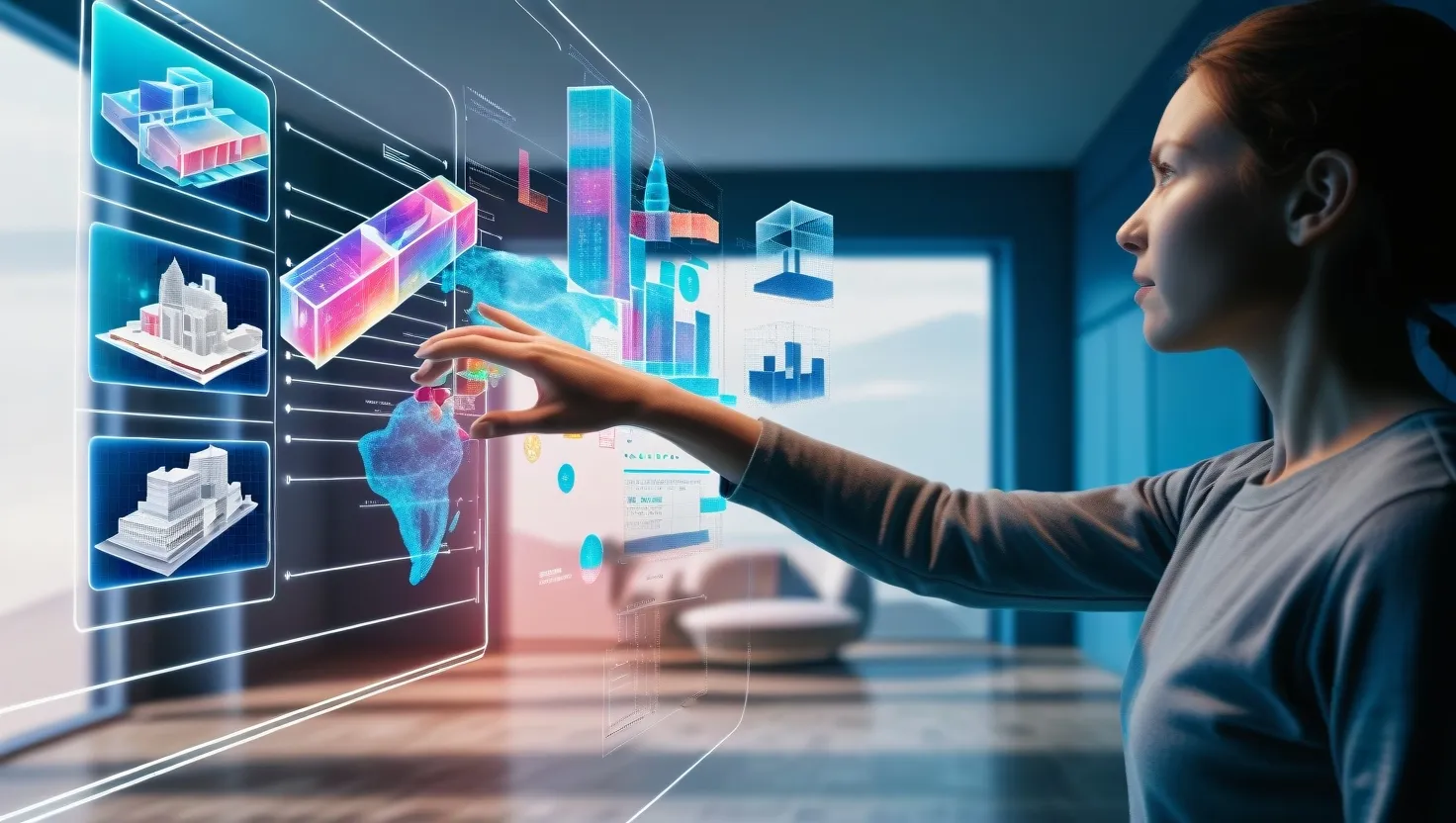
Imagine walking into a room where your decisions and ideas take on a life of their own, manifesting as tangible, three-dimensional objects that you can touch, manipulate, and explore. This is the realm of holographic decision-making, a revolutionary approach that transforms abstract concepts into physical, interactive experiences.
The Power of 3D Visualization
Holographic technology has been advancing rapidly, and one of its most promising applications is in the field of decision-making. By converting digital information into three-dimensional presentations, holograms can make complex choices feel more intuitive and manageable. This is particularly useful in spatial planning and development, where 3D optical illusions can present future development solutions in a clear and easily understandable manner. For instance, visualizing a new residential building as a hologram allows viewers to quickly interpret the design and layout without needing special tools or imagination.
Engaging Spatial Reasoning
Our brains are wired to understand spatial relationships better than abstract lists or charts. Holographic decision-making taps into this spatial reasoning ability, allowing us to interact with our choices in a full-body experience. Imagine moving through a life-sized flowchart, physically rearranging elements to see new connections and pathways. This tactile approach can reveal insights that might be missed in traditional two-dimensional representations.
Financial Projections in 3D
In the realm of finance, holographic projections can turn financial data into colorful, scalable structures that you can walk around and examine from all angles. Visualizing budget allocations, investment returns, or market trends in 3D can make these complex financial concepts more accessible and easier to understand. For example, a holographic model of a company’s financial performance could show revenue streams as flowing rivers, expenses as outgoing waterfalls, and profits as accumulating lakes. This visual representation can help in making more informed financial decisions.
Medical and Educational Applications
The benefits of holographic visualization extend beyond decision-making. In healthcare, holograms are used to create detailed 3D representations of the human body, allowing surgeons to plan procedures with greater precision. Medical students can interact with holographic models of organs, enhancing their understanding of complex anatomical structures.
In education, holographic technology is revolutionizing the way students learn. By providing interactive 3D visuals, students can explore and understand complex subjects more effectively. For instance, students can manipulate individual atomic particles or inspect ancient ruins digitally, making learning a more engaging and immersive experience.
Augmented Reality Integration
The integration of holographic technology with augmented reality (AR) is a game-changer. AR glasses and headsets can display holographic images that blend seamlessly with the real world. This technology can be used in teleconferencing and telepresence systems, allowing individuals to project their holographic images in remote locations, creating a sense of physical presence. In the future, this could revolutionize how we communicate and collaborate remotely.
Practical Applications in Daily Life
Holographic decision-making is not just limited to professional or educational settings; it can also be applied in daily life. Imagine planning a home renovation project using holographic models of your living space. You could see how different furniture arrangements or color schemes would look before making any physical changes. This can save time, money, and the hassle of trial and error.
In automotive design, holographic heads-up displays (HUDs) are becoming more common. These displays project essential information, such as speed and navigation, directly onto the windshield, enhancing safety and minimizing distractions. This technology can also be used in consumer electronics, such as smartphones and tablets, to provide a more immersive and realistic visual experience.
Overcoming Challenges
While the potential of holographic decision-making is vast, there are challenges to overcome. One of the main hurdles is the high computational cost and data requirements for generating high-quality holograms. Current methods often struggle with depicting continuous 3D scenes due to the complexity of specifying defocus responses and occlusion boundaries. However, advancements in deep learning-based methods are addressing these issues, enabling real-time synthesis of photorealistic 3D holograms on consumer-grade hardware.
Another challenge is the physical limit imposed by the size of the hologram’s pixels, which must be about the wavelength of the light to enable diffraction. This requires a significantly higher number of pixels than current high-resolution monitors, making large-scale holographic displays technically demanding.
Future Possibilities
As technology continues to advance, the future of holographic decision-making looks promising. The integration of holography with augmented and virtual reality will further enhance immersive experiences, providing users with realistic, three-dimensional visuals. Holographic telepresence could become a norm, allowing people to project their holographic images in remote locations, revolutionizing communication and collaboration.
In the medical field, holographic microscopy and displays are set to revolutionize diagnostics and treatment by providing detailed 3D visualizations of the human body. Combining holography with 3D printing could also open new avenues for manufacturing highly detailed and customized products.
Personal Touches and Examples
Personally, I have seen the power of holographic visualization in a friend’s architecture firm. They use holographic models to present building designs to clients, allowing them to walk around and interact with the virtual structure. This has significantly improved client satisfaction and reduced the number of revisions needed.
Another example is from a financial advisor who uses holographic projections to explain complex financial concepts to his clients. By visualizing investment portfolios as 3D structures, clients can better understand the risks and returns associated with different investments.
Conclusion
Holographic decision-making is more than just a futuristic concept; it is a tangible reality that is transforming how we interact with and understand complex information. By leveraging our spatial reasoning abilities and providing an immersive, interactive experience, holographic technology can make decision-making more intuitive, manageable, and insightful.
As we continue to push the boundaries of what is possible with holography, we are not just enhancing our ability to make decisions; we are also opening up new avenues for creativity, innovation, and engagement across various fields. Whether it’s in finance, education, healthcare, or daily life, the potential of holographic decision-making is vast and exciting, and it’s an area that promises to continue evolving and improving in the years to come.